That deep amber glow in your favorite agate isn't magic; it's rust. We break down the simple science behind how Mt St Helens volcanoes, ancient gas bubbles, and iron oxide created the Pacific Northwest's most prized carnelian gemstones.

There is a specific feeling every rockhound knows. You are standing in a cold river in Southwest Washington. The water is rushing over your boots. You look down at the gravel bar and see something glowing. It looks like a trapped ember or a piece of hard candy.
You pick it up and hold it to the sunlight. It is a carnelian agate.
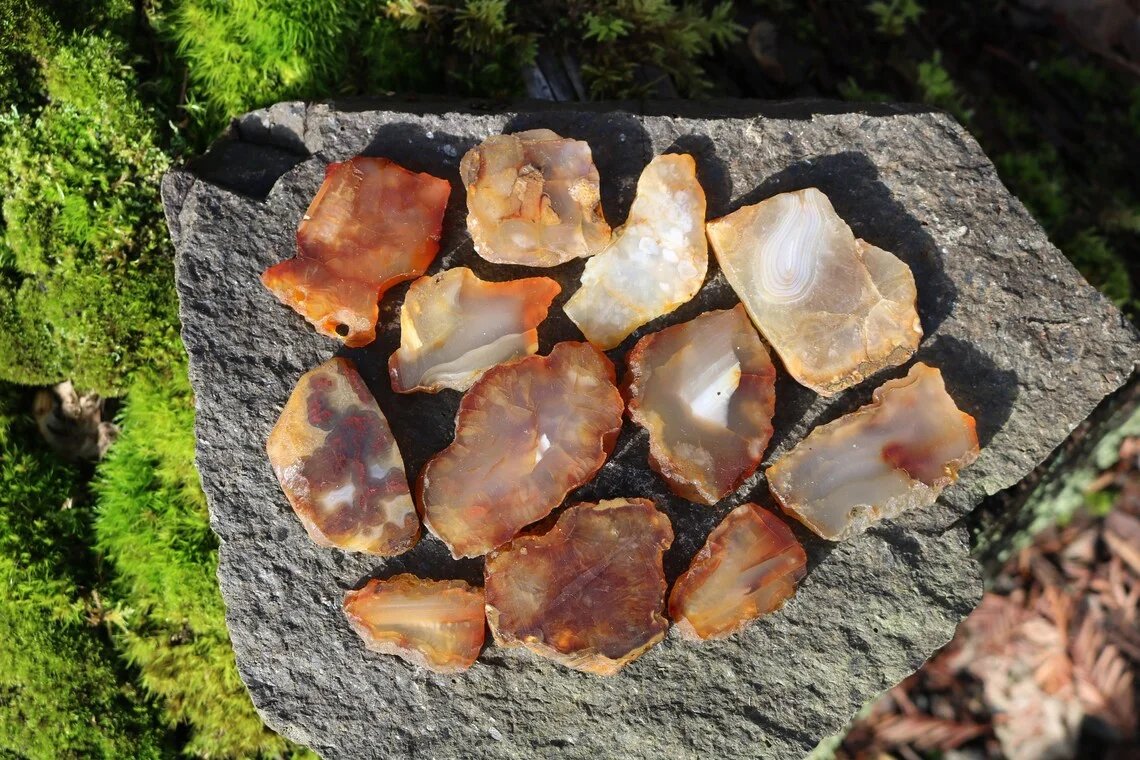
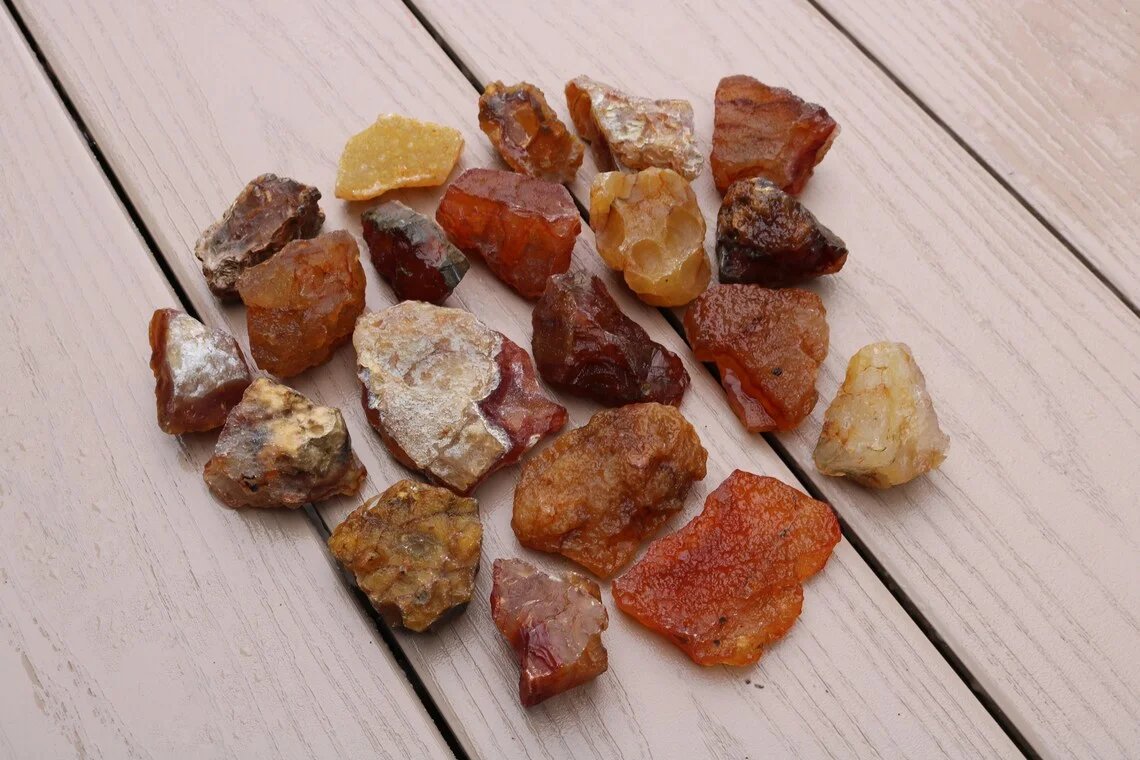
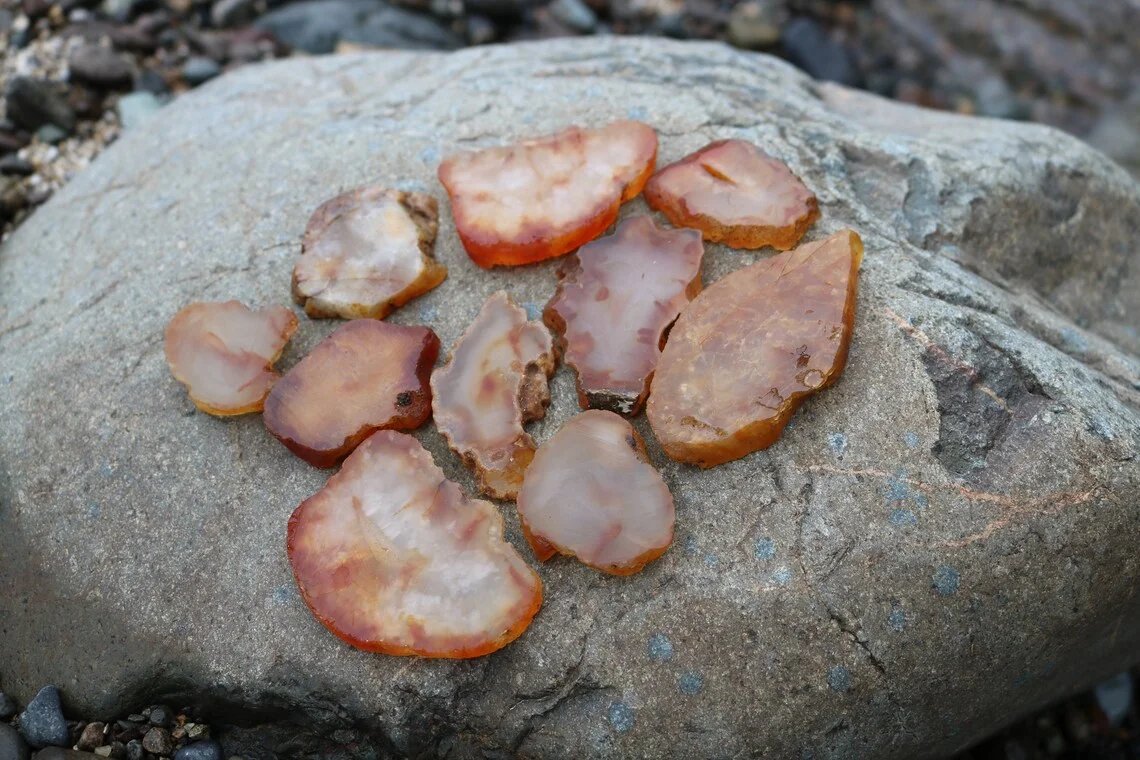
These stones are the prize jewels of the Pacific Northwest. While you can find clear agates or white quartz almost anywhere in the state, the deep reds and bright oranges of a true carnelian are special. They feel like they have a fire inside them.
But have you ever wondered how they got that way?
We know that agates are made of silica. That is the same material as clear glass. So why do the stones near Mt St Helens look like frozen sunsets?
The answer lies in a simple chemical reaction that happened millions of years ago inside the volcanic earth. It is a story of lava, water, and rust. For the complete geological story—from Eocene volcanoes to river gravel—read our guide to the science behind how Washington agates were formed.
The Secret Ingredient
To understand the color, you first have to understand the stone itself.
An agate is mostly silicon dioxide. If you had a pure sample of silicon dioxide, it would be completely clear. It would look like a piece of window glass or a pure quartz crystal.
But nature rarely works with pure ingredients.
The "secret sauce" in our local agates is iron. Specifically, it is iron oxide. This is the exact same compound that forms rust on an old truck bumper.
It seems strange to think that a beautiful gemstone gets its color from the same thing that eats away at metal. But in the mineral world, iron is the master painter. It is responsible for the red in rubies, the yellow in citrine, and the warm hues in our carnelian agates.
When those agates were forming deep underground, trace amounts of iron got trapped inside the silica. It does not take much. A tiny percentage of iron is enough to turn a clear stone into a vibrant orange gem.
The Volcanic Kitchen
You cannot talk about Washington agates without talking about volcanoes.
The area surrounding Mt St Helens is built on layers of ancient basalt. This is dark volcanic rock from lava flows that covered the region millions of years ago. These ancient lava flows are the reason we have agates today.
Imagine a massive lava flow cooling down. As the lava hardened, gases were trapped inside. These gases formed bubbles. Think of the holes in a slice of Swiss cheese or the pockets in a loaf of bread. In geology, we call these vesicles.
Once the lava rock hardened, those gas bubbles remained as empty hollow spaces. They were stone molds waiting to be filled.
Over thousands of years, hot water circulated through the ground. This was not normal rainwater. It was hydrothermal fluid. It was superheated and rich in dissolved minerals.
This water carried silica dissolved from the volcanic ash and rock. But because it was flowing through iron rich basalt, it also picked up tiny particles of iron rust.
How the Color Gets Locked In
This mineral water seeped into the empty gas bubbles in the basalt.
As the water cooled or evaporated, it could no longer hold onto the silica. The silica began to precipitate out of the water. It coated the inside walls of the gas bubble.
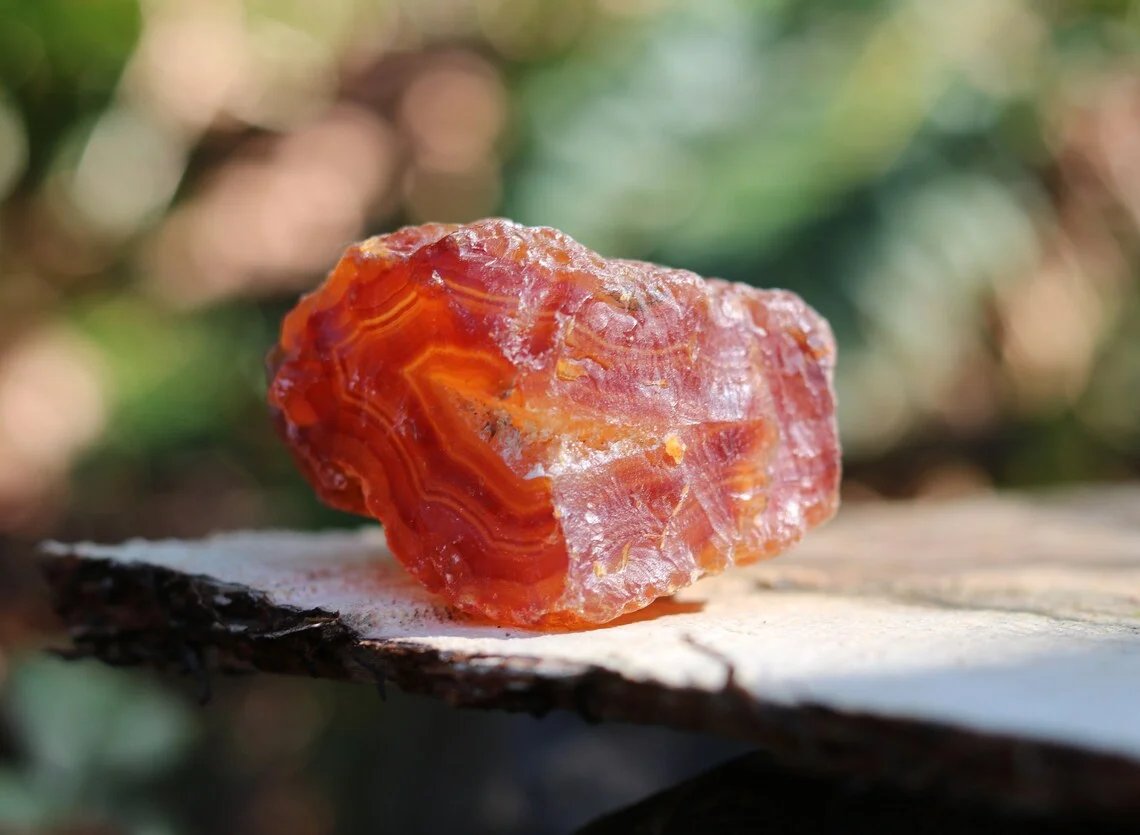
This process happens slowly. It takes a long time. The silica deposits in microscopic layers. This is what creates the banding you see in agates.
If the water passing through the rock that week was pure, it formed a clear or white band.
If the water was carrying a heavy load of iron, it formed a red or orange band.
The heat played a major role here. The iron inside the stone needs heat to turn that deep red color. Since these stones formed in a volcanic environment, the natural heat of the earth literally baked the color into the rock. It is similar to how a potter fires clay in a kiln to set the glaze.
Sometimes you will find an agate that is yellow or tan. This often means the iron is in the form of limonite. If you were to heat that yellow stone, it would likely turn red. Nature just didn't finish the baking process for that one.
Understanding the Bands
One of the best parts of cutting open a carnelian is seeing the stripes.
You might see a dark red outer rim, a band of clear blue, a thin line of stark white, and then a core of deep amber.
This is a timeline of the stone's creation.
The water conditions underground were constantly changing. Maybe a minor earthquake shifted the water flow. Maybe the temperature dropped. Maybe the water source changed and brought in new minerals.
Every time the environment changed, the layer changed.
When you see a dark black fleck or a fern shape in the agate, you are seeing manganese. Manganese is another heavy mineral common in volcanic rocks. While iron paints with red and orange, manganese paints with black and grey.
When you see green earthy moss, you are often seeing chlorite or bits of the host rock that flaked off and got trapped in the jelly like silica.
The white bands are usually pure silica.
The red bands are silica plus iron.
It is a geological barcode. If you know how to read it, you can see the history of the volcanic activity recorded in the stone.
The Crystal Center
Sometimes the process changes before the hole is full.
Agates form from the outside in. The layers build up on the walls until the hole gets smaller and smaller.
In many of our Mt St Helens agates, you will find a center made of crystalline quartz. It looks different than the smooth, waxy agate on the outside.
This happens because the agate ran out of room or time.
The outer layers of agate are made of cryptocrystalline quartz. That means the crystals are microscopic. They are packed so tight you cannot see them. That is what makes agate smooth and translucent.
But as the cavity filled up, the remaining silica water had a smaller space to work in. The conditions allowed the crystals to grow larger. Instead of microscopic sheets, the silica formed into large, six sided macrocrystalline quartz points.
If the crystals grew until they touched each other, you get a solid stone with a quartz center.
If the water ran out before the crystals touched, you get a hollow center lined with crystals. This is a geode.
Why Mt St Helens Carnelians Are Special
You can find carnelian in places like Brazil, India, and Madagascar. But collectors will tell you that Washington carnelian is distinct.
The geology of the Pacific Northwest creates stones with high clarity and intense color.
Some carnelian from other parts of the world is cloudy or muddy. It might look more like jasper. Jasper is also silica and iron, but it is opaque. You cannot see through it because it has too many impurities.
The carnelian we find here is often gem grade. It glows when you put a light behind it.
The vigorous erosive environment here also helps. The soft basalt rock breaks down in our rivers and creeks. The hard agates break free and tumble downstream.
By the time we find them, the river has done the hard work. It has tumbled off the rough edges and polished the stone.
The reason they are so abundant near Mt St Helens is simply because of the sheer volume of volcanic history here. We are standing on layer upon layer of ancient flows. There are billions of gas bubbles in that rock.
Nature played a numbers game. Even if only a small fraction of those bubbles filled with the perfect mix of silica and iron, that still leaves millions of agates waiting to be found.
The Hunt for Red Gold
Searching for these stones is a patience game.
You are looking for that specific wavelength of orange. It stands out against the grey basalt and the white quartz.
Sometimes the iron oxide is only on the surface. We call this a skin. You might pick up a red rock only to chip it and find it is white inside.
But the best stones are red all the way through.
When you find a nodule that is solid red or amber, you are holding a geological miracle. You are holding a pocket of gas that was captured by lava, filled by ancient water, painted by iron rust, and baked by the heat of the earth.
It survived the erosion of the mountain. It survived the tumbling of the river. And it ended up in your hand.
Bringing the Beauty Home
There is nothing quite like the feeling of finding your own carnelian. It connects you to the land and the history of this volcanic region.
But we know that not everyone can trek out to the rivers of Southwest Washington. And even when you do, finding a high quality, gem grade nodule is rare. You can spend all day searching and only find small chips or low quality stones.
We spend our days hunting the creeks and rivers to find the best pieces the Pacific Northwest has to offer. We do the cold, wet work so you can enjoy the beauty of these stones.
If you want to own a piece of this volcanic history, we have curated a selection of the finest natural carnelian agates we have found. These are 100% natural, unheated, and untreated. They are exactly as nature made them. Learn more about how to identify natural vs heat treated carnelian to ensure you're getting the real thing.
Visit our Etsy store to shop our collection of Washington State Carnelian Agates.